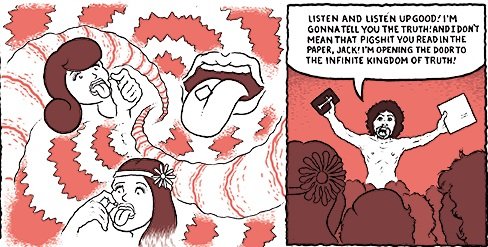
Jake Fairly oozed forth upon the Denver comics scene from the catacombs of the Rocky Mountain College of Art and Design. Be it comics about Neil Armstrong’s corpse, or generally being metal AF, Jake is a guy with considerably hefty night moves. He’s had work published in periodicals such as Westword and the Denver Public Library’s comics newspaper, and has been labeled a “street artist” by Westword magazine.
Author of psychological horror novel Carnality: Dancing on Red Lake, and regular contributor to VICE and The Guardian, Hesse aims to blend journalism and the arts within the pages of Suspect Press, making it both a reflection of our time and an innovative force of creativity. He’s recently released the second book in his series, Carnality: Sebastian Phoenix and the Dark Star, available at several Denver booksellers and on the Suspect Press website. Contact: josiah@suspectpress.com, josiahhesse.com & @JosiahMHesse
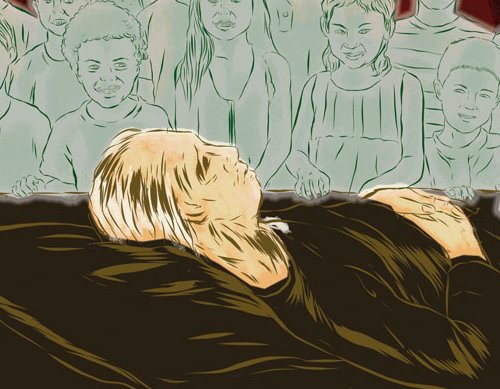
[dropcap]F[/dropcap]ather Ernie was gasping his last breaths when the faces of the children he’d abused appeared before him. It’d been decades since anyone called him “Father,” but that was the way these children addressed him.
“Hello, Father Ernie.”
“Hello, Father Ernie.”
“Hello, Father Ernie,” they said, one after the other, each sounding more confident and empowered than the last. Very different from the shy and trembling children he’d once known. That was so many decades ago, yet Father Ernie instantly recognized every face as they materialized in the darkness, attached to the small bodies he’d vampirically drank from, night after night, seemingly free of consequence.
Until tonight.
He’d moved into this isolated cabin outside Leadville, Colorado two months earlier as a ninety-two-year old retired preacher with stage IV bone cancer and a suffocating bout of pneumonia. Ernie’s grandson (the last living relative willing to speak with him) had been caring for him the last couple years, but after moving Ernie into this cabin, he’d been checking in on his grandfather less and less. Ernie hadn’t seen a soul for eight days when the children showed up.
He’d stopped chemotherapy when moving into the cabin, and there was a brief respite when his chemo side-effects stopped before his cancer symptoms returned. But when dehydration, diaper rash, and excessive lung fluid took hold, Ernie decided to just finish his OxyContin script all at once and have done with it.
Tsunamis of euphoria had been washing over him for the last ten minutes, but they were now interrupted by the most fundamental terror Ernie had ever experienced. A blizzard raged outside his cabin window, the sound of a wolf howling into a moonless night filled his ears when the first boy appeared.
“Hello, Father Ernie,” said the boy.
Paul McCormick, Ernie thought, recognizing the tattered clothes and shaggy hair of the first boy he’d made a move on. It was only once, he told himself.
And then, as if in response to this thought, another child walked into the room.
Like the boy, she appeared in a blue haze, fuzzy around the edges, but still very recognizable. Maria Chary, he recalled, her family were Haitian refugees.
Gales of snow tapped at the cabin window.
The girl’s eyes settled on Ernie’s, and he felt a deep shudder ripple through his body. He was helpless, unable to move or look away, as Maria’s gaze filled him with despair. She was wearing a yellow Sunday dress with tall white socks and polished shoes. It was the same outfit she wore to every church service for five years, long after her growing body caused the seams to stretch and snap.
“I set the template for you, Ernie,” the girl said to her former priest, sounding much older than she appeared. “Poor, a bit dim, and parents who aren’t trusted by people of authority.”
Ernie nodded, drool spilling out the corner of his weakened mouth, recalling the formula he’d devised with Maria. He’d driven her out to a cabin not unlike this one, was given access to this child for three days and two nights, merely because he’d asked.
He’d been allowed a three decade run at this sort of behavior before the Vatican, burdened with more six figure payouts for Ernie than any other 20th century priest (each of them settled out of court), took the rare step of defrocking him for the crime of pedophilia. Characteristically, though, they never admitted to any wrongdoing, and so Ernie’s reputation remained unscathed as he worked his way through several evangelical churches throughout the seventies and eighties. This was the era of the Jesus Freaks, former hippies who ran drug rehab communes with the aim of cultivating born again converts. Most pertinent to Ernie was their taking in junkie parents who could no longer care for their children, separating families and placing the kids in orphanages with no parental contact. Healthcare, education, and religious instruction was given to these kids, free of charge, and was administered by just about anyone willing to volunteer. Ernie was always the first to raise his hand for the privilege.
Miraculously, it wasn’t until 1998 that Ernie got his first ass-beating.
He’d lived until his final days without any legal repercussions for his actions (which was not uncommon for clergy with evil hands), but there were a lot of ass-beatings, mostly from parents or siblings in a blind rage, unable to afford a lawyer but perfectly capable of violence.
Yet none of this curbed Ernie’s appetite, as evidenced by the growing number of children surrounding his deathbed years later. There were so many that the room seemed to stretch to accommodate them. He could see generations of different clothes and haircuts, illustrating the breadth of time he’d been terrorizing children. The years had passed so gracefully, he’d never done the math of how many there’d been. Many of them were filthy, mentally or physically disabled—ideal candidates for a predator.
When each child penetrated the ether and walked into the room, their eyes would lock onto Ernie’s, and his body seemed to gain twenty pounds, sinking deeper into his bed with the weight of guilt—a sensation he’d never experienced in all his life.
Altogether, they appeared so much stronger than they did as confused, silent children in the dark. He was desperate to run, or at the very least look away; wordlessly, each child transferred the emotional burden of Ernie’s touch back onto him. All of the shame, terror, and intimate disgust was lifted from them, and gracelessly flung into Ernie. The ache of self-loathing, the panic attacks of feeling violated, the helplessness of another taking agency over your own body, suddenly rushed into Ernie, dozens of times over, shifting his sociopathic being into that of a spongy empath—and thereby burning his soul alive.
“No, PLEASE! No more,” Ernie pleaded, but the children kept coming, appearing in the windows, in the paintings on the wall, across his hands and feet. They surrounded his bed, growing to inhuman heights, towering over Ernie as he gasped for breath, choking on his own fear.
Then the crowd parted, silence filled the cabin, and at the foot of Ernie’s bed appeared a child different from the others. Instead of a fuzzy blue, this child was colored red. But beyond this, Ernie knew the real difference between this boy and the others: This boy was himself, 85 years ago. The hazel eyes reflected into his own, and for the first time in his life, Ernie began to weep.
“Look!” he shouted at the other children. “I was once a child too! An innocent! The pain I caused you was only an echo of what I absorbed as a child. Take pity on me, please!”
But the child version of himself remained silent, staring into Ernie’s eyes, offering no reprieve from the emotional horror inflicted on him. As seven-year-old Ernie approached his dying self, the dread rumbling in his stomach increased. The boy’s eyes turned to fire, and the bed grew bright and hot. As his bowels evacuated and lungs failed to breathe, Ernie tried to crawl away from his former self, feeling a maddening horror violently clash around his head, like a rabid bird in a cage. Young Ernie climbed onto the bed, approaching the old man on his hands and knees.
Flames climbed the cabin walls, filling the room with blinding waves of heat.
“You killed me long before you touched any of them,” the boy told the old man. “You suffocated me for years, deaf to my screams, killing us both, again and again, your entire life. . . . Now, be deaf no more.”
Father Ernie became lost in the gaze of his former self, feeling his own eyes turn to fire like the boy’s. He felt them boiling in their sockets, then explode across his face, instantly melting his skin down to the skull.
Even though he couldn’t see, Ernie could still somehow sense the children around him. He could sense their transformation into spritely demons, their mouths, hands and feet mutating into instruments of torture. Flames consumed the room as the children climbed onto the bed, nipping, burning and crushing his extremities. Yet even this physical torment was eclipsed by the soul-shattering emotional pain radiating through him, the empathetic misery of facing down his crimes against children.
“We will never leave you, Father Ernie,” they said in unison.
“Say goodbye, Father Ernie.”
“Say goodbye, Father Ernie.”
“Say goodbye, Father Ernie,” they chanted, as the bed slowly sank into the floor.
Author of psychological horror novel Carnality: Dancing on Red Lake, and regular contributor to VICE and The Guardian, Hesse aims to blend journalism and the arts within the pages of Suspect Press, making it both a reflection of our time and an innovative force of creativity. He’s recently released the second book in his series, Carnality: Sebastian Phoenix and the Dark Star, available at several Denver booksellers and on the Suspect Press website. Contact: josiah@suspectpress.com, josiahhesse.com & @JosiahMHesse
[dropcap]F[/dropcap]or anyone that remembers pre-gentrification, pre-legal weed Denver, the all-ages, DIY venue Rhinoceropolis was the beating heart of our city’s underground art scene. Denver staples like the feminist/queer music festival, Titwrench, Denver Noise Fest, and the immersive art festival Fantasia, were born and thrived at Rhino. A young (pre-Elon Musk) Grimes performed there, and electronic musician Pictureplane (Travis Egedy) spent years performing and organizing shows at Rhino before moving to Brooklyn. And there’s Flosstradamus, Wolves In The Throne Room, and Lightning Bolt…we could go on.
Back then Rhinoceropolis was in a dark corner of a warehouse district, where artists endured poverty but enjoyed freedom. And then a dark cloud by the name of RiNo (River North) Arts moved in, appropriating the name of the DIY venue while transforming the neighborhood into a cartoonish playground for developers and corporate-funded art.
This was followed by the tragic fire at the Oakland DIY venue, Ghost Ship, where 36 people were killed and a panic about underground venues permeated the nation. Despite years of routine inspections from the Denver Fire Department, Rhinoceropolis was shut down by city officials shortly after the Ghost Ship fire, leaving several of its members homeless (including weirdo genius Colin Ward, who committed suicide shortly after) and a massive hole in the Denver arts scene.
Fast forward two years and Rhinoceropolis is back open, having complied with all the bureaucratic demands thrust upon them by various civic agencies. Rhino director John Gross has put in countless hours and energy making sure the venue has all the walls, ramps, electrics, bank accounts, permits and contracts needed to make it a legit, above-ground venue.
But can the spirit of DIY arts be maintained in a space that works hand in hand with city officials? We traveled out to the newly renovated Rhinoceropolis to speak with John Gross about this cultural conundrum, and what the future holds for one of our city’s finest arts institutions.
Honestly, after hearing about all the changes you had to make to get this place up to code, I was expecting Rhinoceropolis to look like a slick, AEG venue. But it still feels like the same place. What’s different about running this place today compared to before the shut-down?
Before, when we were living here and putting on events, it was like throwing a house party in my living room, so I didn’t care whether or not I turned a profit. It was about having a good time, and making sure the bands had enough gas money to get to the next place. For anything like this to work, the focus has to be on taking care of the artists.
Today I’ve got these laws and bureaucracy to conform to that we never bothered to deal with before.
What did you do before that you can’t now?
The biggest one is we can’t live here anymore. But I’ve also gotta operate as an LLC, and if we pay any bands more than $600 I gotta have them fill out a 1099. Which would never have crossed my mind before. It was all cash. But now we’ve got a square reader, a business bank account, online ticket sales, all the stuff that you would do when you think of a legit arts organization.
Photo by Tom Murphy
After the Ghost Ship fire and Rhino being raided, was there a period of time when you thought: “Fuck it, Rhino is over”? How big of a blow was all that to your spirit?
The Ghost Ship fire was still on my mind when the cops showed up that freezing cold night in December 2016. It was less than a week since the fire. Two of my personal friends died in that fire, who I’d met through this place.
The moment I saw it on the news, I called my friend and said “we’re gonna need to be careful.” But there was never any point in my mind that this was a “death trap,” which was a common phrase in the news about Ghost Ship. With the DIY scene there’s always an attitude of self-policing, so I told my team that we’re gonna have to up our game. In the back of my mind I thought: The city is going to be paying attention to us.
And then, soon enough, the Sheriff was here, social services, fire department, the press, all these city agencies watching us while we moved our stuff out. That was when I got a call from Vince from Meow Wolf and he asked, “What do you need?” And that’s when I thought we might have access to resources to keep this thing alive.
Photo by Tom Murphy
Did you have a sense of what it would take to keep it alive?
Absolutely not. I don’t know how anyone could without a background in commercial real estate and international building code. And yeah, there were times when I had doubts that we could pull this off. But I started hearing from a lot of people, who reached out to say how much they thought Rhinoceropolis meant to their community. I heard from a lot of people who said all-ages spaces are incredibly important for music culture. There are a lot of people who had their first exposure to the DIY culture here, the first time they could relate to people performing, and first time they experienced art that challenged them. And that gives them the idea that “hey, if they can do that maybe I can.” Then a few months later they called me and said, “I’ve got a band, can I book a show?”
Was Colin Ward’s death a factor in wanting to push on with Rhinoceropolis?
Colin was my partner in all this. He was going to have a big leadership role in the new version of the venue, and his suicide hit me really hard. I think it hit everyone really hard. I can’t know what was in his mind, but all of the hurdles, delays, red-tape and city bureaucracy stuff [at Rhinoceropolis] had a big impact on his mental state, and maybe made him do what he did. For him to suddenly not be there, I thought, “I can’t do it without him.” But at the same time, I had to keep going because that’s what he would’ve wanted.
Photo by Tom Murphy
Everyone knew him as a great artist, but how was he as an event organizer?
He was amazing at that. Fantasia was the biggest, craziest…It was a lot like what Meow Wolf does, but a little more of the chaotic, ecstatic, over-the-top type of thing. And that was all him. He was manic when it came to organizing that thing. He would pull people together from very diverse backgrounds.
While the space itself doesn’t look wildly different than it did before, this neighborhood has changed exponentially. What’s it like trying to put on a show here late at night?
Yeah, this area is the new Cherry Creek. We have had some noise complaints, but the cops just came in to tell us to turn it down a bit, and that was it. I try and go around and talk to the neighbors, but the trouble is I don’t live here anymore. This neighborhood went from being a forgotten industrial wasteland to hot property and the gateway to downtown. And that’s when they started rebranding it as an arts district.
Photo by Tom Murphy
And appropriated the name RiNo, right?
Yeah, I’ve been saying that forever. The people from RiNo deny it and deny it. Was it too much of a coincidence? I think so. We’ve always had a problematic relationship with the arts district. They did support us financially when we were being shut down though. I don’t think they wanted us gone. I would like us to be more involved with them. The problem is a lot of the people from the DIY community don’t want anything to do with them.
Do you feel like a diplomat between the DIY community and mainstream arts and law enforcement?
Absolutely. A lot of the people from the DIY community are around 21. And I’m 41. And they ask, “Why do we need to deal with the city? This is bullshit.” And I say that we have to be legit now. You used to be able to do whatever you wanted, for years, but not anymore. Or maybe it’s just a generational thing, I don’t know. It’s complicated.
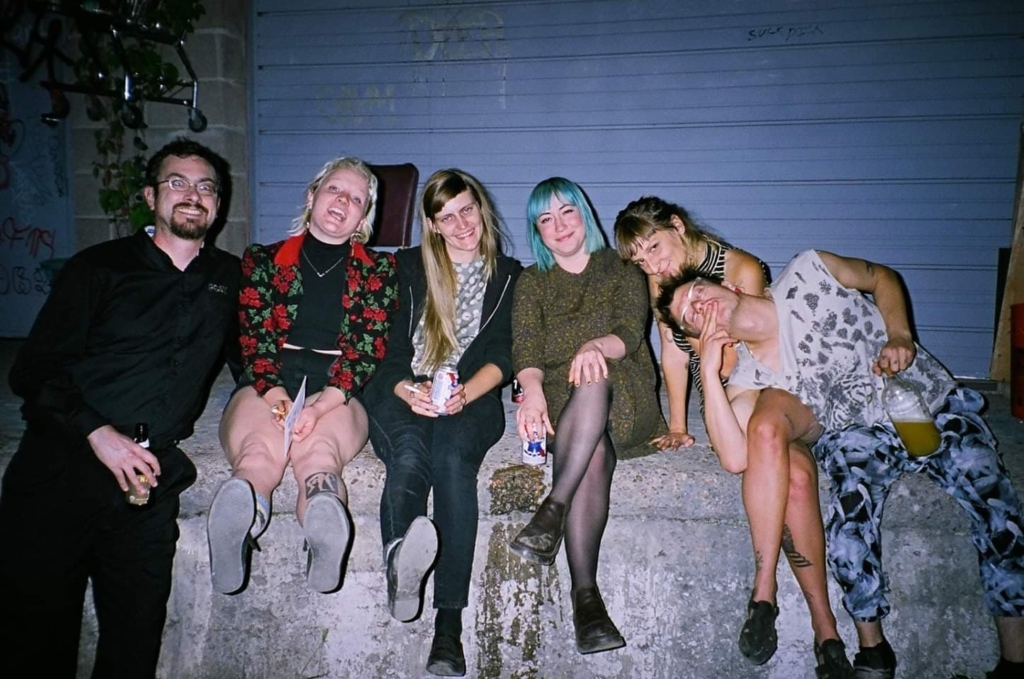
Photo by John Gross (on far left)
Yet I like the idea that there are still 21-year-olds out there saying, “Fuck the city.” I went to that Community Forum on Safe Spaces, with city officials and the DIY community, and when the Q&A started, the first kid up there let out the most horrendous screechy howl into the mic for something like two minutes. At first I was aghast, but then I thought: They’re all meeting with the city on the city’s terms, maybe the city should get a taste of this weirdo art world.
That’s funny, because at the time I was upset about it. That was what made our first architect quit the project. But then I thought: Maybe this guy isn’t a good fit for us. And in the end we were able to find an architect that was an artist and knew this community. There are a lot of people out there who are really skilled professionals who support the DIY community and aren’t just in it for a check.
Author of psychological horror novel Carnality: Dancing on Red Lake, and regular contributor to VICE and The Guardian, Hesse aims to blend journalism and the arts within the pages of Suspect Press, making it both a reflection of our time and an innovative force of creativity. He’s recently released the second book in his series, Carnality: Sebastian Phoenix and the Dark Star, available at several Denver booksellers and on the Suspect Press website. Contact: josiah@suspectpress.com, josiahhesse.com & @JosiahMHesse
by Mar Williams, Christina Procter, & Josiah Hesse
Mar Williams is a Denver artist, hacker, and all around adorable scamp, working internationally in a number of fine art and digital mediums. They maintain an interest in the artistic applications of emerging and open source technology. Also cats, bugs, and queer shit. Mar is a founding member and chairman of Cabal Gallery – a South Broadway non-profit contemporary arts space.
Christina Procter is a writer, photographer, and filmmaker based in Santa Fe. Co-writer of the feature-length documentary Meow Wolf: Origin Story, which premiered at SXSW 2018, she’s also a consulting editor for TREND magazine. Her portraiture will show at SITE Santa Fe in May.
Author of psychological horror novel Carnality: Dancing on Red Lake, and a regular contributor to VICE and The Guardian, Hesse aims to blend journalism and the arts within the pages of Suspect Press, making it both a reflection of our time and an innovative force of creativity. He’s recently released the second book in his series, Carnality: Sebastian Phoenix and the Dark Star, available at several Denver booksellers and on the Suspect Press website.
There is an old cliche that “real” artists aren’t interested in making money. Or that if you are focused on making money, you must be a shit artist. Sometimes things do play out that way, leading to great talents being ripped off, and hacks making a killing on hotel room art. But it doesn’t have to be that way, says Vince Kadlubek, co-founder and CEO of the Santa Fe, New Mexico art collective Meow Wolf.
Since its inception in 2008 as an underground music and arts venue, Meow Wolf has set a new standard for what artists can accomplish when they pool their resources and aren’t afraid of playing a little footsie with capitalism. In 2016 the collective landed their first permanent space—a converted bowling alley owned by Game Of Thrones author George RR Martin—and there created the world-renowned exhibit, House of Eternal Return, which has hosted more than 400,000 visitors in less than two years.
Kadlubek has had no qualms about monetizing the popularity of Meow Wolf, and in turn his organization has been turning some of that capital into grants for various organizations, not least of all Denver’s DIY arts community, who received a total $74,000 in the form of 20 different grants just this year.
We recently spoke with Kadlubek about Meow Wolf’s upcoming plans for a Denver location, what our arts community can learn about the success they’ve had in Santa Fe, and why getting along with business and government doesn’t have to kill your creativity.
For those that don’t know, what is Meow Wolf?
Meow Wolf is a creative company that grew out of an art collective. Our main product, the thing we like to create the most, are immersive exhibitions. We’ve done around 30 temporary exhibits, but we have a permanent one in Santa Fe.
But we’re also in entertainment media, AR, VR stuff. We’re looking to do feature films, documentaries, merchandising, product development, whatever. Our aim is to keep the spirit of the artist collective alive and open to whatever people are passionate about.
How much of Meow Wolf is an extension of Santa Fe and the arts culture down there?
It’s kind of based on Santa Fe in that it’s a psychedelic, weird, cyber-spiritual, culty, new age kinda thing. There’s a lot of Santa Fe influence on Meow Wolf, but there’s also a lot of national aesthetics we’re pulling from. We’re just doing what we’re doing.
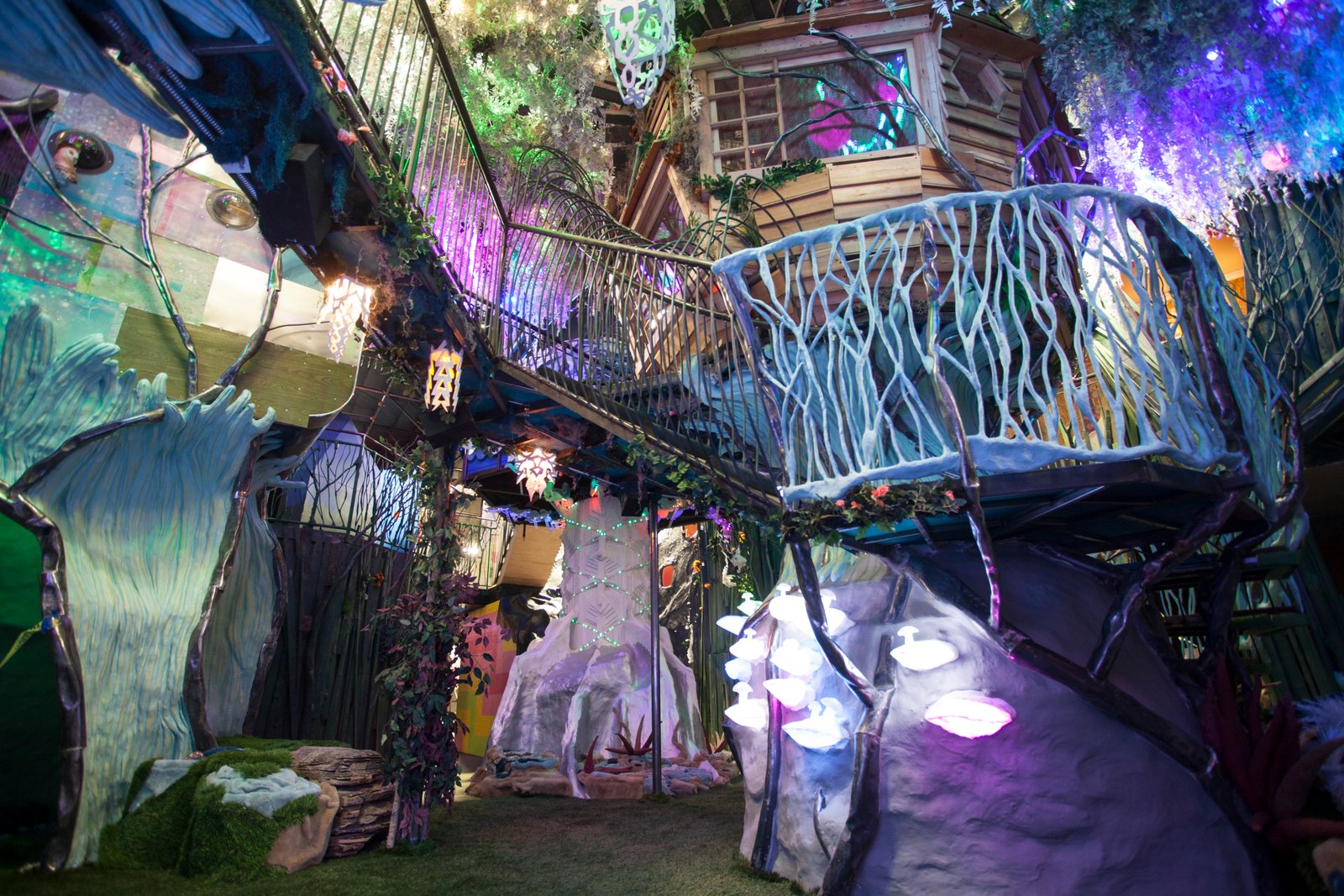
Meow Wolf House of Eternal Return
In this age of income inequality, Meow Wolf seems to be pursuing a new economic model for artists and collectives. What can other artists communities learn from what you’re up to?
I think artists getting comfortable with business-minded people—and business-minded people getting comfortable with artists—is very important. That needs to happen if we want to have the arts and creativity survive in this economic climate. Artists need to apply some business-type thinking to their work.
Art exhibits get a lot of traffic, they’re an event that’s cultural and important and people want to be there. And yet it’s considered totally wrong to charge admission to an art exhibit—that mentality needs to change. I could have four thousand people lined up outside the door to see my paintings, but if no one’s buying them and everyone just wants to be there at the event, then I need to rethink this and consider charging everyone five bucks. Because there’s a valuable exchange happening there.
In addition to a distrust with the business community, in Denver the DIY community has a strong apprehension toward working with city officials. Do you think it’s possible for underground communities to have a good relationship with the city without losing the culture, politics and lifestyle that make them what they are?
I don’t see it as a need to balance to strike, or compromise. What you’re seeing in Denver is an issue with fire codes: An inspection from the city on DIY spaces finds that they’re not up to code and everyone gets kicked out. The honest truth of it is that artists don’t want to live in spaces that aren’t up to code, and the city doesn’t want to kick artists out—so there is some common ground there.
From my perspective, the conversations and progress happening in Denver on this issue are far beyond most any major city in the country. Denver is having the most upfront, honest attempts on both sides to make this situation right.
Rumors have been circulating for some time about a permanent Meow Wolf instillation in Denver. What can you tell us about that?
Denver is at the top of the list of cities that we want to go to. We’re still working it out. We’re trying to find a large piece of real estate where we can do a badass exhibit, and real estate in Denver is complicated and expensive. I think we’ll have a space locked in soon, but there’s a lot of work to do even after that. We’d like to announce something in November.
How can ambitious art projects like Meow Wolf serve as an antidote to all the damage that gentrification has wrought on the Denver arts community?
When money pours in from the tech industry, or marijuana industry, or whatever, artists can’t keep up, they get priced out of their own neighborhoods, and their art spaces get turned into high rise condos.
But it’s not going to be solved by slowing the economic growth of a city. Artists and creative industries need to be able to keep up with the economic growth curves, so that artists aren’t poor. And that’s the problem here: artists don’t have work. The world doesn’t value artists, businesses don’t value artists, and cities don’t value artists.
So our hope [with Meow Wolf] is to show the economic value of artists. And hopefully artists can start to represent themselves in ways that produce value. And new businesses can be developed that are dedicated to supporting creatives. So hopefully artists can start getting bigger paychecks. And with bigger paychecks they can keep up with the economic growth curves of the city.
Author of the psychological horror novel Carnality: Dancing on Red Lake, and regular contributor to VICE and The Guardian, Hesse aims to blend journalism and the arts within the pages of Suspect Press, making it both a reflection of our time and an innovative force of creativity.
Jake Fairly oozed forth upon the Denver comics scene from the catacombs of the Rocky Mountain College of Art and Design. Be it comics about Neil Armstrong’s corpse, or generally being metal AF, Jake is a guy with considerably hefty night moves. He’s had work published in periodicals such as Westword and the Denver Public Library comics newspaper, and has been labeled a “street artist” by Westword magazine.
I didn’t care about the painting, but I sure pretended to.
Still blinded after biking through a March blizzard, my eyes strained to focus on the painting as I entered the living room. I’d been out working as a dog walker all day, fighting through the snow drifts with expensive purebreds, and was exhausted by the time I got home that night. While I was out one of my roommates had taken it upon themselves to graffiti a painting of mine in the living room.
There were twelve of us living together in that giant house, trading in basic necessities for the freedom of only paying a hundred bucks each in rent. There was no heat or hot water and a metropolis of mice lived behind the walls, but it afforded most of the residents the luxury of not having to work. They’d figured out how to make rent on their art, but I couldn’t lean into that kind of madness the way they could. I was a writer, and making money off of my sentences felt beyond me at the time. My bones craved the security of employment, which lead me to walking dogs in a blizzard.
Several of my roommates never left the house, consuming pots of coffee and spliffs until dawn each night; painting, sculpting or writing themselves into a coma. Often their creative juices sprayed onto the walls, floors and ceiling, carving penis sculptures out of stairway banisters and drawing self portraits in their own blood on kitchen cabinets. This was all fine considering the landlord had no intention of ever setting foot in the house. But when someone drew the on my painting, I became hysterical.
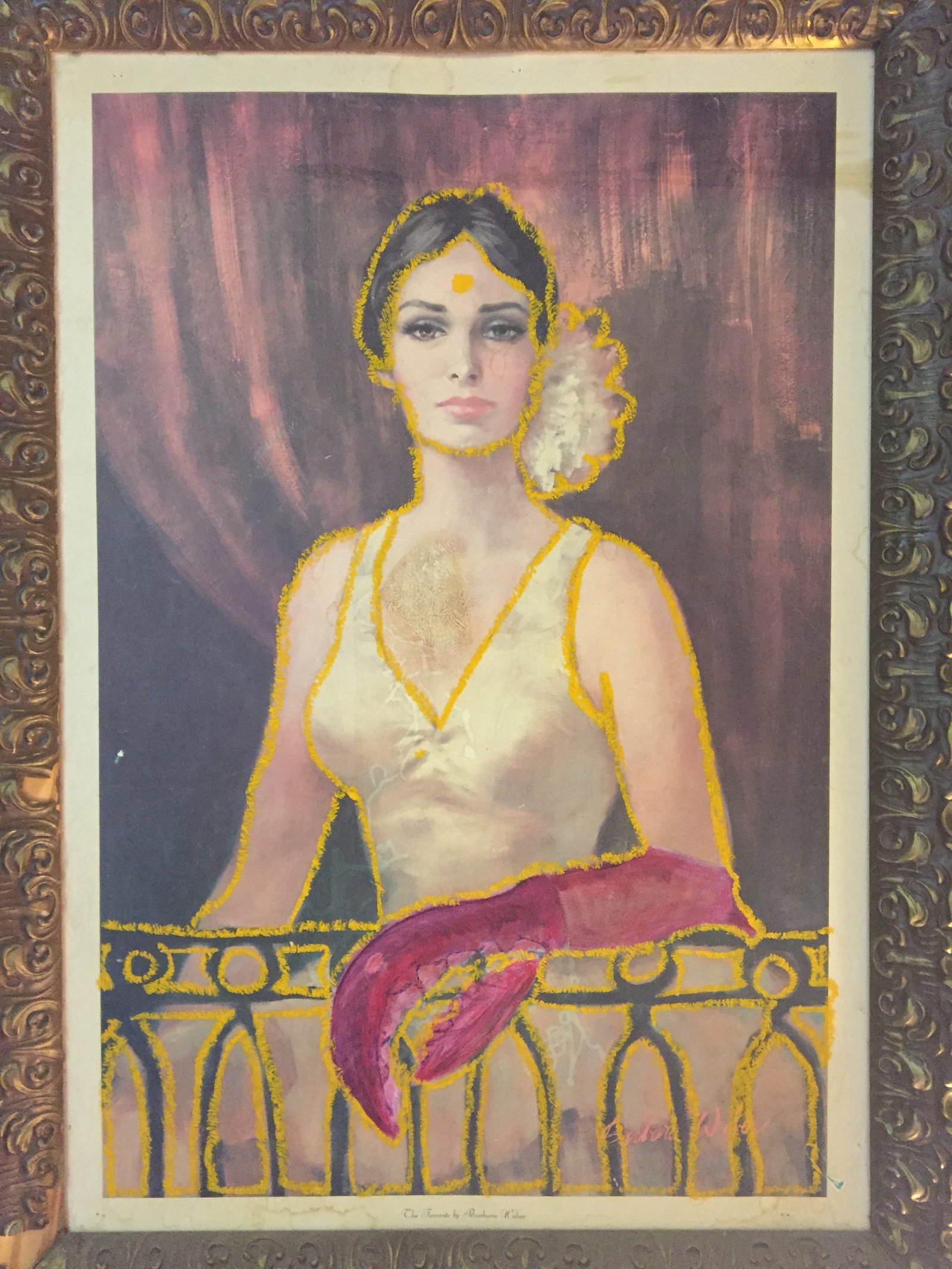
It wasn’t anything I cherished, just a cheap a portrait of young debutant titled “The Favorite.” The girl was poised and elegant, her hair pulled back into a clean bun while resting one arm on the iron railing of a bed. One of my ambitious roommates apparently thought that arm would look better as a big red lobster claw, and took it upon themselves to make the necessary changes.
No one would confess to doing it, but I simply wouldn’t let it go.
I brought it up at every house meeting, the twelve of us circled around the fireplace for warmth, tossing in phone books stolen from the neighbor’s porch. I told them the painting was a birthday present from my ex-girlfriend, that she’d painted it as a self-portrait, and it was the only possession I truly cherished. Which was all bullshit, but they didn’t know that. Most of these people I’d met on Craigslist, and had only known them a few weeks.
It was true that I’d recently gone through a breakup, hence my living with a dozen strangers in a drafty mansion that was only an electric bill away from being considered a squat house. So I was probably just trolling for sympathy.
I honestly couldn’t even remember how I came about the painting.
More than that, I actually really loved what had been done to it.
It went from being a hotel-hallway dud to a piece of comic surrealism.
But I would never let any of my roommates know that.
I refused to lean into their madness.
They never seemed to worry about money and, like an Al Qaeda soldier in the mind of George W. Bush, I hated them for their freedom. They seemed to just absently float through existence on a cloud of inspiration, while I was riding my bike around Denver every winter’s day from 9 to 9 so I could walk dogs sporting collars worth more than my life for eight dollars an hour.
After that, I could only squeeze in an hour or two of writing each night, with a space heater between my legs and a quickly drained box of Franzia on my desk, before I collapsed in a pile on my mouse-shit speckled floor. Their lives were a blank slate, an empty highway, or at least that’s the way I saw it. While I was the Horatio Alger go-getter with a heart of gold. All that Republican Party, Ayn Rand bullshit from my childhood was playing out in a passive aggressive roommate squabble, mostly of which only existed in my head.
My resentment only solidified one frigid morning when I came downstairs to find Tina Turner smeared with blood. It was a 1969 photo of Turner performing on stage, shaking with preternatural madness as sequins shot out from her dress like exclamation points. I’d bought the poster in Omaha years earlier and had it framed. And now the frame was smashed.
At some point the night before someone had gotten drunk and punched Ms. Turner. The glass was sprayed out from her face, the poster smeared with blood underneath.
Again, I shamed the group at house meetings over the vandalism, but secretly adored the look of the thing. The blood and spider-webbed glass only intensified Tina’s explosive energy, not to mention the violent imagery being a provocative commentary on the domestic abuse she was enduring at the hands of Ike Turner when the photo was taken.
But still I fabricated stories about my mother singing me Tina Turner songs as a child, and that this framed poster was a gift from her at my going away party when I left Iowa. Ever since Mom died from pancreatic cancer last Easter, I said during one house meeting, the only thing that brought me comfort was looking at this picture of Tina Turner.
So whoever punched Tina essentially punched my dead mother, I told my roommates.
After that, I had to quickly leave the room whenever my Mom would call.
Our landlord eventually had the property foreclosed on him, and we were given the boot by the bank. The Tina Turner painting had been sacrificed in the fireplace weeks earlier, after one roommate had consumed a pint of Morning Glory seed tea, covered himself in Papua New Guinea tribal paint designs, and sang “What’s Love Got To Do With It” while wiggling his fingers above the smoldering poster.
But I managed to keep the lobster claw painting.
Eight years later it still hangs in my living room.
I keep it as a reminder to try and lean into the madness.
A ghostly memo from the past, bringing me comfort in the knowledge that life’s chaos will often bring pain and the need for sympathy, but if you can just manage to keep your mouth shut and ride out that pain, there may be a badass lobster claw painting waiting for you on the other side.
Author of psychological horror novel Carnality: Dancing on Red Lake, and regular contributor to VICE and The Guardian, Hesse aims to blend journalism and the arts within the pages of Suspect Press, making it both a reflection of our time and an innovative force of creativity. He will be releasing the second book in his series, Carnality: Sebastian Phoenix and the Dark Star, in August 2018.