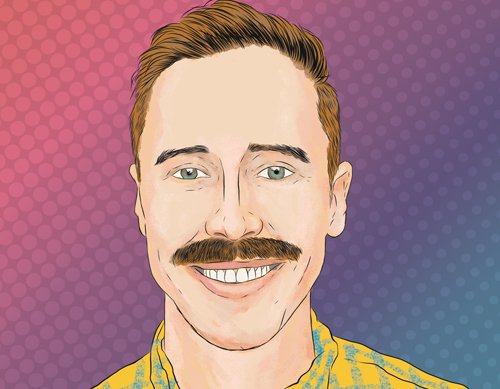
Lonnie MF Allen is an oft-published illustrator, writer, and graphic designer. He is an award-winning cartoonist and was named as one of Westword’s 100 Colorado Creatives.Lonnie is the cat-wrangler for the Denver Drink & Draw meet-up. His work has been published by Dark Horse, Image Comics, and he’s been nominated for an Eisner Award. Find his work at lonniemfallen.com.
Kelsi Jo Silva is an artist and comic illustrator
based out of Denver, Colorado. She lives in a
small apartment with a small horde of plants,
comics, and coffee mugs.
[dropcap]I[/dropcap]n 2010, at the height of the recession, when a friend admitted to considering grad school for literature, I begged him to turn around. Of course, I’d nerded out on Emily Dickinson and African postcolonial lit on my own degree a few years earlier, but I was left more indebted than inspired and wound up hustling at a coffee roaster and homeless shelter to pay the bills.
Six months later, between coffee bean deliveries, my coworker Chloe found out I could write and walked straight up to the owner: “Did you know this guy has a fucking English degree?” The one thing I was most embarrassed of, my professional chagrin, ended up leading to a raise and my first writing project: a barista training manual.
While I didn’t become a full-time technical writer, I did get better at translating skills from one context to another. I had to learn how to see all the skills I’d already developed as valuable and build from there.
Most creatives understand the challenge of pivoting and repackaging. Your chosen medium may be oil landscapes or three-act plays, but how do you distribute—and make money on—your work right now? And if your medium is term limited (like dance) or site dependant (like installation art), how do you develop other revenue streams? I spoke to three artists who created new paths for themselves along their way to finding creative (and economic) fulfillment.
If you’ve ever felt bittersweet fuzzies before the Robin Williams mural on 14th Ave, or taken a shameless selfie at a “Love This City” mural in RiNo, Golden Triangle or the Arts District on Santa Fe, you’ve seen SoGnar Creative Division’s colorful work. Today, their clients include Denver Zoo, Denver Public Schools, the Broncos, Budweiser and many towns across Colorado. Their journey to large-scale murals, however, was far from direct.
SoGnar’s founder Pat Milbery was a pro snowboarder, so his company took the best parts of that culture—music, gnar and art. Their submarine logo spoke to an underground aesthetic and DIY ethos: “We were communicating tons of guerilla marketing: stickers, wheatpasting and a lot of propaganda. For the first handful of years, very little of what we did was done with permission.”
Milbery’s athletic success inspired a snowboarding camp for kids and multiple collaborations with sports and marketing companies, effortlessly shuttling from designs and prints to in-store and experiential installations.
To switch to full-time art, though, Milbery had to leave the sport behind. “As much as I loved what I was doing, I saw a bigger calling. I was scared because it was a shift in image. If we pulled out of the [snowboarding] market, would people still have our back?” (Spoiler alert: they did.)
Denver artist Kaitlin Ziesmer, whose work straddles the line between illustration and fine art, never expected to be designing merchandise—but now buttons, pins, books and stickers are part of her regular monthly income.
“I started making products so that my friends could afford my work,” Ziesmer says, “I was surprised that I really enjoy designing packaging. From a practical standpoint, the better the packaging, the better it would sell. It makes creating the work that much easier, less dependent on selling originals. Selling originals is awesome, but you can’t rely on it.”
Now that Ziesmer’s work is available in eight different Denver stores, she can finally afford a studio, which has boosted her art production. Recently, she began creating sculpture and even murals, including a PBR-sponsored polar bear on Colfax Ave.
If you’re looking to break into the retail world, Ziesmer explains, most stores will either offer consignment—paying you monthly or quarterly when your work sells—or wholesale: paying you in a lump sum. Be sure to ask how often you’ll get paid and how much you’ll make (splits can range from 50/50 to 70/30, with the store taking more for overhead). Ziesmer says her biggest lifesaver has been a spreadsheet that tracks her payments. If a store owner forgets to send a check, her spreadsheet reminds her to send a gentle reminder. Finally, you’ll need to know if the store will be tracking inventory, or if you’ll need to come by and refill it yourself. Before a big art project comes up, Ziesmer calls her vendors to see if they’re well-stocked, so she can put her full attention on her art.
At the same time, the risk of others exploiting your innovation is real. This happened to Ethan Bach from Alt Ethos, an experiential design company: “We developed an interactive mirror for live events, but this year, three to four similar products came out that claim to do it better.” His solution? Double down on what makes your offering unique. For Alt Ethos, customer service and sustainability give them an advantage over other creative companies.
Your path to new, lucrative avenues for your art may not be clear immediately. Some of Ziesmer’s items sell better at one store than another; sometimes they don’t sell at all. It takes time and persistence to launch something new. “You gotta be passionate about it, you gotta give it all you got, and you can’t see any obstacles,” says Bach.
Milbery clarifies that when developing new services or products, purpose always trumps profit: “If you’re going to venture into a new place, do it 110%, but don’t have huge expectations or assumptions about financial gain. I go into new projects with a purpose of what we’re accomplishing and how this can create an impact.”
Fund Your Art: Residencies & Fellowships
Some creative careers offer a narrow path through the woods (lucky you, architects!), but for composers, new media artists, entrepreneurs and the rest of us, it’s often half bushwacking, half stumbling into fields of opportunity. One respite from this choose-your-own adventure are residencies and fellowships.
Many artists crave these structured spaces to grow and experiment. Fellowships offer a stipend for work you have done or will do, while residencies typically provide you space to work, or work and live. You might also have access to specialized tools or mentorship.
Spots may be competitive, but don’t let that keep you from applying. In fact, psych yourself up right now—you’re 100% worthy of developing your skills, and you deserve to invest in yourself.
In the event you’re not accepted, consider designing your own residency by asking friends and family for a space to retreat and work. Remember that the endgame is spending dedicated time on your craft—not just a line on your resume. Even a weeklong sabbatical can benefit your art.
Music
Residency, The Music District If music is a business, this is the business gym for musicians to work out at. For less mixed metaphors, contact Julie@themusicdistrict.org.
Artist in Residence, Nocturne Jazz & Supper Club Get instant feedback on your jazz licks (for better or worse) from live audiences during your weekly performances in this 4–8 week residence.
Visual Arts
Artist in Residency, Anderson Ranch, $750 or $1,500 fee Who doesn’t love a mountain resort? Spend five weeks in spring, or ten weeks in fall honing your medium in Snowmass Village. Apply by Feb 15.
Film
Fellowship, The Outdoor Film Fellowship Like a good reality TV show, this experience brings a team of students and recent grads together for a month to create a high-impact film.
Commitment Grants + Emerging Filmmaker Fellowship, MountainFilm, $1,000-5,000 award Telluride’s iconic documentary film fest makes a ton of money; each year, they pay it forward to emerging filmmakers’ new projects.
Writing
Writing in Color Fellowship, Lighthouse Writers, Free classes This yearlong program prepares one writer of color to publish their first manuscript. Application due in the spring.
Fort Lyon Fellowships, Lighthouse Writers, $2,500 stipend For four weeks, work on a writing project while teaching creative writing classes to homeless veterans (~10 hours/week). Applications open in the fall.
Performing Arts
Guest Artist Presenting, Control Group Productions You can dance. You can jive. Have the time of your life developing a new production. Apps due in February.
Multidisciplinary (visual, performing, etc.)
Creative in Residence, Denver Art Museum, $7,500 stipend Who hasn’t dreamed of taking over at least a corner of the museum? If you know how to inspire collaboration and visitor engagement, apply in the fall for this April–September gig.
The Residency Program, Elsewhere Studios, $600-850 fee/month Literally any artist or creative person (“scientists, teachers, and other creative thinkers”) can apply for this year-round Paonia residency. What’s holding you back?
Artist in Residency, Platteforum, $250/week + studio space Be the weird creative mentor that inspires high school students to take risks! This 6-8 week studio residency culminates in an exhibition in your medium.
Artist Residency, Redline Contemporary Art Center Two years. A dedicated studio. It doesn’t get any more Denver than this Five Points, community-centered space. Applications open in March 2020.
*Don’t see a good match in our list? There are hundreds more to search from in the Alliance of Artists Communities’ database.
Originally from rural New Mexico, Paul Bindel spent five years teaching writing before transitioning full time into marketing at Doghead Creative, a digital marketing firm that specializes in content writing, strategy and social media.
and I will plant sunflowers in-between your aching poles
where divinity transforms into monstrosity and
back again.
Bring me royal stargazer lilies to dissolve,
mandarin marigolds to gnaw upon,
ruby red roses to hang upside down—
pretty pictures to cut up into art.
Bring me a sad story and a black heart
that I can alchemize into laughter, making
cascading chains of illusive memory pains,
silently molding fears into sand castles.
Bring me your most guarded, treasured desires.
I will walk your dehydrated imagination to the brinks of reality
where the river banks are flooded daily
with wishes from the living and the dead.
Bring me a dream to eat,
a wall to bend, a wound to lick,
a scar to dissolve, a levee to breech,
and we can lie safely together in the shadows.
I am not a piece of your puzzle. I am
not the fragmented collection of
a story you are constructing. I am
a landscape moment you can escape into.
I cannot give you everything, you say, but I can
offer enough of the moon to satiate you
until it becomes blue again. Can you truly
learn to dissolve your face?
When you look at me, do you
see circles of forever, or merely space
to play with time? Will you come to claim
your gaping hunger at its root?
Adrian H Molina is a wordsmith, time traveler, and shapeshifter, first cousin to jaguars and quetzals native to the “Americas.” He can be spotted in the portals of your imagination. He was recently featured at the Crestone Poetry Festival. He eats money in exchange for creative ideas. Everything is made up, and he knows his worth. Molina is creating new worlds. You can follow his writings and musings within the matrix on IG @MolinaWrites.
Arna Miller is an illustrator and screen printer in the Denver Metro area. She works out of her home studio and draws inspiration from book illustrations, vintage packaging, matchboxes, magic show posters, and early-20th century illustrations. Her aim is to create narrative illustrations that depict magical moments, operating under the guiding rule of “possible, but not likely.”
[dropcap]F[/dropcap]or anyone that remembers pre-gentrification, pre-legal weed Denver, the all-ages, DIY venue Rhinoceropolis was the beating heart of our city’s underground art scene. Denver staples like the feminist/queer music festival, Titwrench, Denver Noise Fest, and the immersive art festival Fantasia, were born and thrived at Rhino. A young (pre-Elon Musk) Grimes performed there, and electronic musician Pictureplane (Travis Egedy) spent years performing and organizing shows at Rhino before moving to Brooklyn. And there’s Flosstradamus, Wolves In The Throne Room, and Lightning Bolt…we could go on.
Back then Rhinoceropolis was in a dark corner of a warehouse district, where artists endured poverty but enjoyed freedom. And then a dark cloud by the name of RiNo (River North) Arts moved in, appropriating the name of the DIY venue while transforming the neighborhood into a cartoonish playground for developers and corporate-funded art.
This was followed by the tragic fire at the Oakland DIY venue, Ghost Ship, where 36 people were killed and a panic about underground venues permeated the nation. Despite years of routine inspections from the Denver Fire Department, Rhinoceropolis was shut down by city officials shortly after the Ghost Ship fire, leaving several of its members homeless (including weirdo genius Colin Ward, who committed suicide shortly after) and a massive hole in the Denver arts scene.
Fast forward two years and Rhinoceropolis is back open, having complied with all the bureaucratic demands thrust upon them by various civic agencies. Rhino director John Gross has put in countless hours and energy making sure the venue has all the walls, ramps, electrics, bank accounts, permits and contracts needed to make it a legit, above-ground venue.
But can the spirit of DIY arts be maintained in a space that works hand in hand with city officials? We traveled out to the newly renovated Rhinoceropolis to speak with John Gross about this cultural conundrum, and what the future holds for one of our city’s finest arts institutions.
Honestly, after hearing about all the changes you had to make to get this place up to code, I was expecting Rhinoceropolis to look like a slick, AEG venue. But it still feels like the same place. What’s different about running this place today compared to before the shut-down?
Before, when we were living here and putting on events, it was like throwing a house party in my living room, so I didn’t care whether or not I turned a profit. It was about having a good time, and making sure the bands had enough gas money to get to the next place. For anything like this to work, the focus has to be on taking care of the artists.
Today I’ve got these laws and bureaucracy to conform to that we never bothered to deal with before.
What did you do before that you can’t now?
The biggest one is we can’t live here anymore. But I’ve also gotta operate as an LLC, and if we pay any bands more than $600 I gotta have them fill out a 1099. Which would never have crossed my mind before. It was all cash. But now we’ve got a square reader, a business bank account, online ticket sales, all the stuff that you would do when you think of a legit arts organization.
Photo by Tom Murphy
After the Ghost Ship fire and Rhino being raided, was there a period of time when you thought: “Fuck it, Rhino is over”? How big of a blow was all that to your spirit?
The Ghost Ship fire was still on my mind when the cops showed up that freezing cold night in December 2016. It was less than a week since the fire. Two of my personal friends died in that fire, who I’d met through this place.
The moment I saw it on the news, I called my friend and said “we’re gonna need to be careful.” But there was never any point in my mind that this was a “death trap,” which was a common phrase in the news about Ghost Ship. With the DIY scene there’s always an attitude of self-policing, so I told my team that we’re gonna have to up our game. In the back of my mind I thought: The city is going to be paying attention to us.
And then, soon enough, the Sheriff was here, social services, fire department, the press, all these city agencies watching us while we moved our stuff out. That was when I got a call from Vince from Meow Wolf and he asked, “What do you need?” And that’s when I thought we might have access to resources to keep this thing alive.
Photo by Tom Murphy
Did you have a sense of what it would take to keep it alive?
Absolutely not. I don’t know how anyone could without a background in commercial real estate and international building code. And yeah, there were times when I had doubts that we could pull this off. But I started hearing from a lot of people, who reached out to say how much they thought Rhinoceropolis meant to their community. I heard from a lot of people who said all-ages spaces are incredibly important for music culture. There are a lot of people who had their first exposure to the DIY culture here, the first time they could relate to people performing, and first time they experienced art that challenged them. And that gives them the idea that “hey, if they can do that maybe I can.” Then a few months later they called me and said, “I’ve got a band, can I book a show?”
Was Colin Ward’s death a factor in wanting to push on with Rhinoceropolis?
Colin was my partner in all this. He was going to have a big leadership role in the new version of the venue, and his suicide hit me really hard. I think it hit everyone really hard. I can’t know what was in his mind, but all of the hurdles, delays, red-tape and city bureaucracy stuff [at Rhinoceropolis] had a big impact on his mental state, and maybe made him do what he did. For him to suddenly not be there, I thought, “I can’t do it without him.” But at the same time, I had to keep going because that’s what he would’ve wanted.
Photo by Tom Murphy
Everyone knew him as a great artist, but how was he as an event organizer?
He was amazing at that. Fantasia was the biggest, craziest…It was a lot like what Meow Wolf does, but a little more of the chaotic, ecstatic, over-the-top type of thing. And that was all him. He was manic when it came to organizing that thing. He would pull people together from very diverse backgrounds.
While the space itself doesn’t look wildly different than it did before, this neighborhood has changed exponentially. What’s it like trying to put on a show here late at night?
Yeah, this area is the new Cherry Creek. We have had some noise complaints, but the cops just came in to tell us to turn it down a bit, and that was it. I try and go around and talk to the neighbors, but the trouble is I don’t live here anymore. This neighborhood went from being a forgotten industrial wasteland to hot property and the gateway to downtown. And that’s when they started rebranding it as an arts district.
Photo by Tom Murphy
And appropriated the name RiNo, right?
Yeah, I’ve been saying that forever. The people from RiNo deny it and deny it. Was it too much of a coincidence? I think so. We’ve always had a problematic relationship with the arts district. They did support us financially when we were being shut down though. I don’t think they wanted us gone. I would like us to be more involved with them. The problem is a lot of the people from the DIY community don’t want anything to do with them.
Do you feel like a diplomat between the DIY community and mainstream arts and law enforcement?
Absolutely. A lot of the people from the DIY community are around 21. And I’m 41. And they ask, “Why do we need to deal with the city? This is bullshit.” And I say that we have to be legit now. You used to be able to do whatever you wanted, for years, but not anymore. Or maybe it’s just a generational thing, I don’t know. It’s complicated.
Photo by John Gross (on far left)
Yet I like the idea that there are still 21-year-olds out there saying, “Fuck the city.” I went to that Community Forum on Safe Spaces, with city officials and the DIY community, and when the Q&A started, the first kid up there let out the most horrendous screechy howl into the mic for something like two minutes. At first I was aghast, but then I thought: They’re all meeting with the city on the city’s terms, maybe the city should get a taste of this weirdo art world.
That’s funny, because at the time I was upset about it. That was what made our first architect quit the project. But then I thought: Maybe this guy isn’t a good fit for us. And in the end we were able to find an architect that was an artist and knew this community. There are a lot of people out there who are really skilled professionals who support the DIY community and aren’t just in it for a check.
Author of psychological horror novel Carnality: Dancing on Red Lake, and regular contributor to VICE and The Guardian, Hesse aims to blend journalism and the arts within the pages of Suspect Press, making it both a reflection of our time and an innovative force of creativity. He’s recently released the second book in his series, Carnality: Sebastian Phoenix and the Dark Star, available at several Denver booksellers and on the Suspect Press website. Contact: josiah@suspectpress.com, josiahhesse.com & @JosiahMHesse
It happens. You think you’re old enough. You’re in love. Or not. You planned it. Or not. Caution is thrown to the wind before the soft baby foot of reality kicks in, the blue double lines on a stick show you the parallel lives you’ll lead if you do or do not choose to keep it. But the engagement is set, the cervix is thick, a quiet knowing penetrates your bones—you’re about to be changed by someone you don’t yet know. You tell your lover you’ve made your choice. You quit your vices, you get a place together. You play house and giggle over stupid things, like cooking barefoot in the kitchen. You are told what to eat and what to avoid, you heed the advice, or not, and hope for the best. No one thinks to tell you that being occupied by a child can be a traumatic experience, or that your now-sober mind will perceive the world around you with new clarity.
When you walk, proud-bellied forward into the wild world, you will get unsolicited advice and un-consensual belly-pats. You’re asked probing questions about the gender of your unborn child, on the assumption there are only two genders, determined by genitalia. You are repeatedly given that powerful ominous warning: Your life will never be the same. On the day of birth, no one can explain the skull-shocking, soul-shaking realization: I have only ever been child. Now I will only ever be parent. The magnitude of the realization deepens as you realize how triggering it is to have your sore body on demand for someone else’s needs. That you signed up for this.
Elders in grocery aisles will tell you, “Enjoy it! It goes by so fast!” You smile, sleep-deprived and weepy, and carry on, your baby snoring on your chest. You sneak brief glimpses of their tiny, furrowed sleeping brow, acutely aware that it will soon be replaced by the glowering glare of a teenager. The elders don’t mention the slow-motion. How you will sit breathless, nearly motionless for an hour, your arm asleep under the weight of their perfectly-formed soft skull, so full of things they have yet to learn. The well-meaning elders failed to mention how you will sit as still as a rock in water as time slowly wears away at you and places the sediments of your understanding onto your child as you sit, open shirted, nipple exposed, dripping with milk, and cold with exposure as you muster some inner Buddha calm and just stare at their fluttering eyelids and sticky cheeks, listening to their tiny rapid breaths, reminding yourself to be still, the dishes can wait, it all goes so fast.
Two years of dishes later, you are chasing after an adorable uncivilized being who doesn’t quite speak the language and whose default volume is screaming. You were told it would go by so fast, no one warned you a day home with a toddler was, in actuality, a week, or how loud you’d curse when a toddler chomps down with new teeth. You will have to learn the hard way, through work, or separation, that a day without your child is a seemingly endless, sun-less season. No one tells you that having children is by no means an antidepressant. But to be fair, it is fairly effective suicide prevention.
No one explains that somewhere around age five, the kind eyes and patient smiles of strangers disappear and are replaced by indifference, impatient glances, and even sneers. Meanwhile, you are torn between disciplining your child to be more socially palatable, and climbing with them under the bookstore table to drink hot chocolate and make farting noises and read comic books.
If you do make the choice to bring another life into this world, there are no limits to the lessons you will learn, and there are so many people ready to dispense their wisdom and bad advice on the topic of parenting. As you seek counsel…I say take heed of the tired clichés, for they’re there for a reason…Your child will be your truest teacher and mirror, so study up, and sleep when you can, but not too often…because, it does go by so fast.
Eliza is a poet, parent, painter, carpenter, singer/songwriter, queerdo and preacher to choirs. They like to hike, garden, and scream with the punk band Black Market Translation. Their new book, “Treat Me Like You Treat the Earth,” will be released by Suspect Press on July 19th at Mutiny Information Cafe. Come say hi. You can find more of their work and contact them at ElizatheBeth.com
Erica Keeling is an analog photographer and multimedia artist living in Seattle, Washington. Her photographs explore various social conditions, pulling from her own experience, that of those close to her, and what she witnesses on a larger scale. She exhibits nationally and enjoys creating for various performing artists and musicians. In sharing her work, she honors the connectivity of the human experience as well as the unseen becoming seen. More of her work can be seen at EricaKeeling.com
Dylan Edwards is an award-winning queer & trans comic artist, best known as the creator of TRANSPOSES and VALLEY OF THE SILK SKY. His comics have been published in anthologies from Dark Horse, Fantagraphics, and OniPress. His work has also appeared on The Nib, PEN America, and Splinter News. You can find more of his comics at http://www.studiondr.com/
I am very frustrated that you refuse to publish or even acknowledge my essay series “Straight, White Men Are The Real Persecuted Minority.” Your failure to recognize my right to exist only reinforces my conviction that males without color (MWC) are the true victims of our time. I moved to Denver from Boston six months ago, and this city has been wildly unaccommodating to my needs as a MWC. My LoHi condo re-fuses to grant me extra parking spaces for my ‘65 Jaguar or my stretch Humvee, forcing me to sell them at below-market value! For years I’ve treated my PTSD from being a MWC with the aromatherapy of fresh, Maine lobster with European white truffle butter, but your discriminatory grocery stores do not even carry these items, forcing me to have them airlifted by private jet daily. I recently attended an ACLU benefit concert for abortion assistance programs, and was repeatedly laughed at when suggesting MWCs should have their own benefit concert. Additionally, no one from the ACLU responded to my request that all attendees of this concert be reminded to please not make eye-contact with me at any point during the evening, as I find this threatening to my value as a man. If you continue to ignore me and my fellow MWCs, we will be forced to declare Suspect Press a publication that does not respect the plight of straight, white men in today’s anti-male society.
Dear Suspect Press,
I’m afraid I’ve lost all my marbles. I thought they were under the couch, but I looked there. Nothing. Then, I thought they may be around the entrance of the Walgreens on Delancey where I could last feel them bulging in my pocket and shifting around. Not there. I was told by an old woman in a dream that they just might be near the truck stop where I used to look at myself in the superb fluorescent lighting found in the bathroom so I could check for bugs. Nope, not there. I was wondering if I could take out a spread for my dear lost marbles before I go fishing tomorrow. It’s the second mishap since I blew all my fuses. I was working through something on my 1970s IBM cabinet that I bought since I caught wind of the NSA peeping through the fancy modern ones. Now if I can only get more duct tape for the outlets that I KNOW my neighbors are watching me through.
–Scared and Scarred in Scranton
Dear Editors,
The lacquer of newness began to fade upon my best work. I became torn between choosing the destruction of what was left and starting anew or more easily dressing up old material with an untimely veneer. The foundation of all that I had made, the years of meticulous and careful perfection was undoubtedly solid, but even the best efforts are undone by time. The conundrum is whether something is better that has been worn and destroyed by use, or preserved in all its original glory–static and unchanged. You all are I assume, some of the few people that could appreciate how my objectively mundane but internally monumental dilemma could weigh on a soul. I say I assume so because of your publication’s seeming knowledge and insight into the depths of the human heart and mind. So, more plainly, should I tear up my porch and build a new one, or should I just sand it down and revarnish? Thank you for your answer ahead of time.
–Michael Danberry
Dear Suspect Press,
Imagine my surprise when I opened up your magazine only to discover that there was absolutely nothing related to information in regards to America’s suspected criminals but had instead a bunch of angry poems and questionable comics. So here I am, writing a letter to you editors to ask what is up with the name? I get that you probably had to throw the word “press” in there in hopes that people would realize you guys were actually a semi-legit magazine instead of a bunch of random crap thrown together- but why suspect press? Is it like to say “Hey everyone, you should suspect there to be some sort of press in here!!” kind of thing? Was that just to push the idea across that you guys are just as real as a magazine like Vogue or Natural Geographic? Honestly, I’d change your company’s name if you hope to make it out into the real world. I am extremely disappointed.